
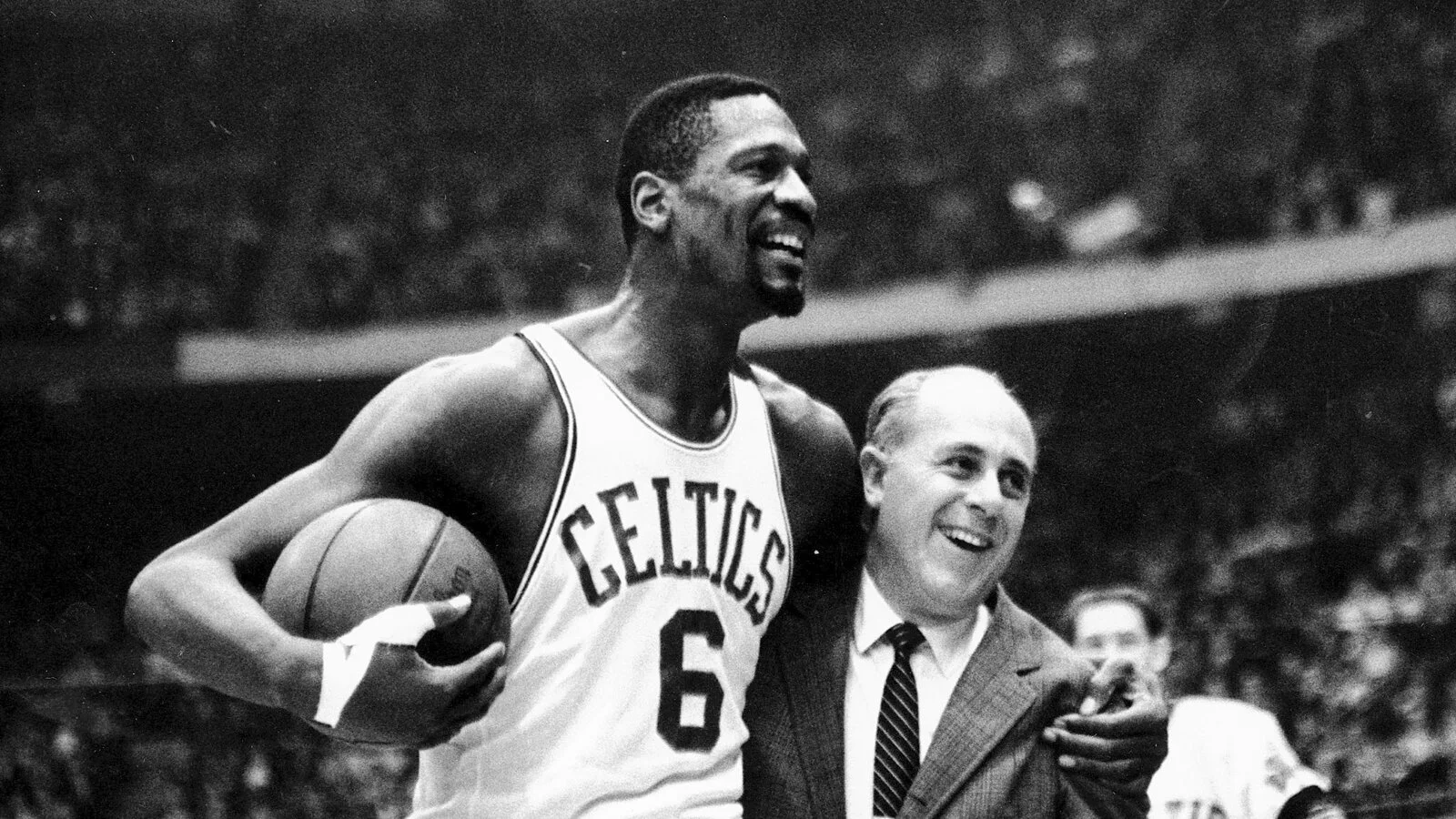
Bill Russell wearing Lakers gold sounds impossible now. In 1971, Jack Kent Cooke apparently tried anyway.
A detailed Reddit history post resurfaced the strange moment when the Lakers owner, still bruised by years of losing to Russell's Celtics, made a pitch to bring the retired Boston legend back into the NBA. The idea was wild on its face: Russell beside Wilt Chamberlain, Jerry West and Elgin Baylor, with Los Angeles trying to build the most decorated veteran group the league had ever seen.
The context explains why Cooke would even think about it. Russell had retired after the 1969 Finals, but before that he had repeatedly blocked the Lakers from the championship they believed was finally theirs. Cooke's tenure had already included four Finals losses to Russell's Celtics, including 1965, 1966, 1968 and 1969. That last one was the most painful.
In 1969, Los Angeles had Wilt, West and Baylor. Boston was older, Russell's knees were a constant issue, and the Celtics were not viewed as the same machine that had ruled the decade. The Lakers had home court for Game 7 and Cooke was so confident that he reportedly prepared a celebration inside the Forum. Balloons marked for a Lakers championship were held above the floor. Flyers on the seats described what would happen when, not if, Los Angeles won.
The Celtics saw it. Russell saw it. West saw it. The detail has become part of NBA mythology because Boston then did exactly what Russell teams so often did. The Celtics built a lead, held off the Lakers late and won 108-106. Russell made a key defensive play in the closing seconds, and the balloons stayed where they were. West won Finals MVP in a losing series, still one of the most bittersweet individual honors in league history.
That ending deepened the Lakers' desperation. A year later, Los Angeles lost another Game 7, this time to the Knicks, even with Willis Reed badly limited by injury. West and Baylor were still without a ring. Cooke had stars, money and a glamorous building, but the team could not get clear of the ghosts Russell had left behind.
That is what makes the 1971 approach so sharp. Russell had moved to Los Angeles after retirement and was around the Lakers scene enough to attend a night honoring West. According to the story Russell later told in an oral history setting, he sat near Cooke during the event and then received a call a couple of days later. Cooke had decided he wanted Russell to come out of retirement and play for the Lakers.
Russell's answer cut straight through the fantasy. He pointed out that the Lakers were already paying Wilt Chamberlain, then asked how Wilt would feel about backing him up. It was funny, cold and probably the cleanest possible reminder that this was never just about filling a roster spot. Russell and Chamberlain had their own complicated history, and the idea of Russell joining Wilt in Los Angeles carried more baggage than most front offices could manage.
The basketball version of the pitch was not impossible to understand. Russell was still the defining winner of the previous era. Even diminished physically, he represented defense, rebounding, leadership and the psychological edge that had tortured the Lakers for years. Cooke was not chasing a normal free agent. He was chasing the person who had most often stood between his franchise and validation.
A lineup with four names that central to the 1960s would have been less like normal roster-building and more like collecting the decade's entire argument in one locker room.
But the human version made it feel impossible. Russell had spent his career as the Celtics' center, coach and conscience. His relationship with Boston fans was deeply complicated, and he had reason to feel alienated from the city, but that did not mean the Lakers were a natural next stop. He had also left the sport suddenly in 1969 and did not appear eager to reopen his career just to solve Cooke's problem.
The Chamberlain layer is just as important. Russell had criticized Wilt after the 1969 Game 7 injury controversy, when Chamberlain left late with a knee issue and then was not put back into the game. Their relationship reportedly went cold for a long stretch. Asking Russell to return as Wilt's teammate, on the Lakers, after that Finals wound, was more than ambitious. It bordered on delusional.
Still, the story captures the emotional logic of that Lakers era. Cooke had watched Russell beat him too many times. West had absorbed too many Finals losses. Baylor was running out of body and time. Wilt gave Los Angeles a superstar center, but even he had not ended the cycle in 1969 or 1970. From Cooke's view, maybe the only way past Russell was to put Russell on his own side.
It did not happen, and in hindsight that may be cleaner for everyone. Russell stayed retired. Baylor soon stepped away after injuries emptied out what remained of his game. The Lakers then found their release in 1971-72, winning 33 straight games and finally taking the championship over the Knicks. West and Chamberlain got the Los Angeles title that had escaped them, and Cooke got the one ring of his ownership tenure.
That ending gives the failed Russell offer its strange shape. The Lakers did not need Russell to win the next year, but the fact Cooke tried to get him says plenty about the scars left by the Celtics dynasty. Russell was not only the opponent. For Los Angeles, he had become the symbol of every door that had closed.
That is why the story still works decades later. It is not just a what-if lineup with Russell, Wilt, West and Baylor. It is a snapshot of a franchise so haunted by one rival that it briefly imagined recruiting him as the final answer.


No comments yet. Start the conversation.