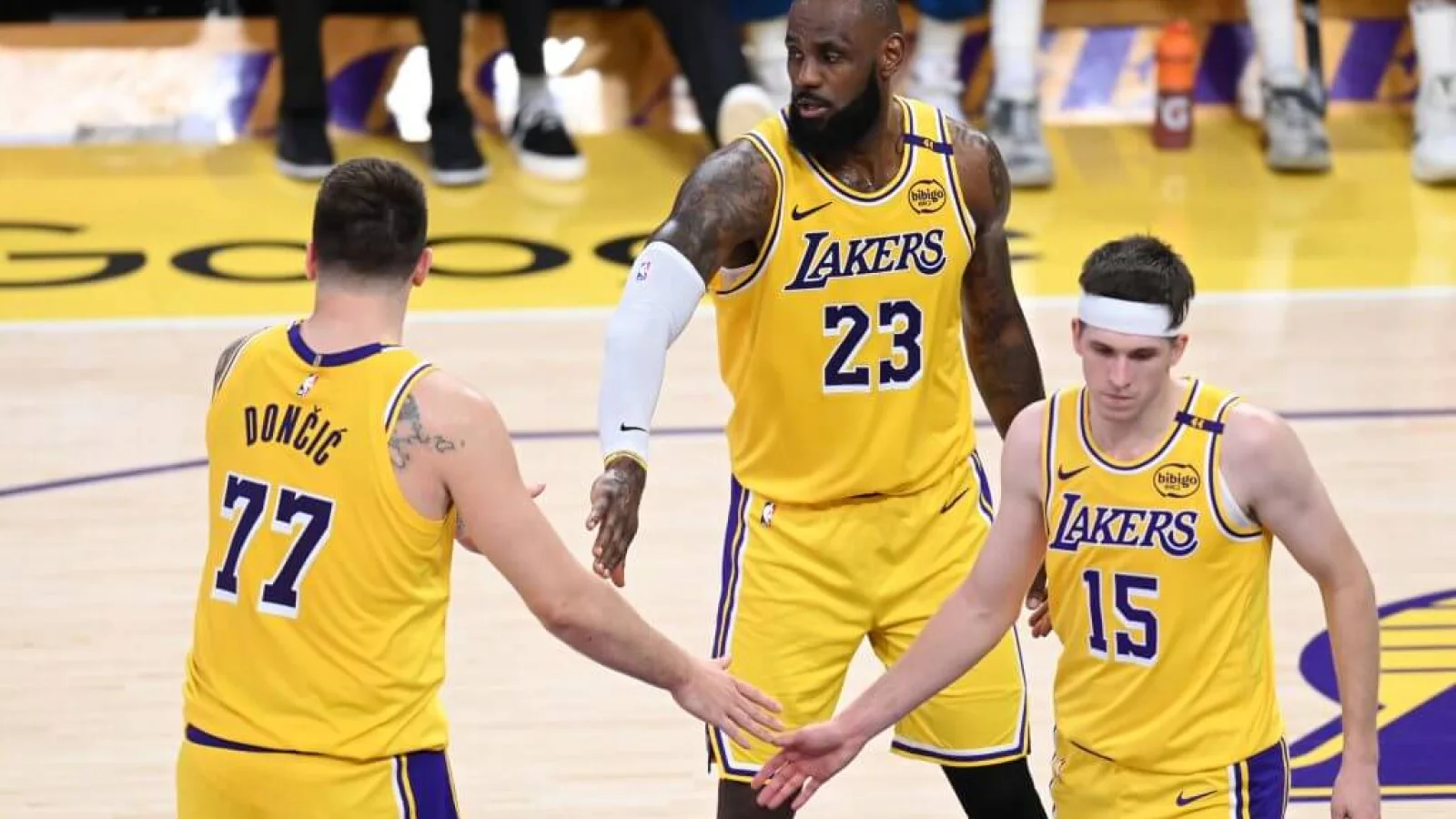
The Lakers have offseason cap space in theory. Around the league, that flexibility is reportedly being treated with skepticism.
Brian Windhorst wrote that rival teams see Los Angeles as having "phantom" cap space because the number is not as clean as it looks. The projected $50 million figure already accounts for Austin Reaves' $21 million cap hold. Reaves is an unrestricted free agent, though, and he can and is expected to sign for significantly more.
That leaves the Lakers with a strange starting point. Reaves is a high priority, but keeping him mostly protects what they already have. It does not count as a major upgrade around Luka Doncic.
The next step is harder. Windhorst noted that if the Lakers want to materially improve, they have to replace the production of LeBron James and Rui Hachimura and then add to it with that same block of cap space. They also do not have a recent draft pick ready to take on a bigger rotation role, despite four straight drafts feeding into the roster pipeline.
That is why one argument inside the discussion is fairly conservative: re-sign the team's own players, keep the deals short and manageable, and hope Doncic is healthier late in the season. It is not a splashy answer. It may be the path that keeps the Lakers from spending assets just to solve one problem.
The biggest basketball need is still at center. Windhorst wrote that Los Angeles badly needs a high-level starter there. The market is not friendly. Jalen Duren of the Pistons and Walker Kessler of the Jazz are viewed as the top free-agent centers this summer, but both are restricted free agents and both teams have indicated they want to keep them.
A sign-and-trade is possible. So is a normal trade for another center. Windhorst mentioned Isaiah Hartenstein as an example if Oklahoma City ever had to consider moving him. Either path would take cap space and assets, which is exactly the kind of double cost the Lakers are trying to manage.
Kessler might be the more direct pressure point. He has excellent size, brings a defensive-specialist profile and has been far apart from the Jazz in contract talks since last summer. The Lakers could try to stress Utah with an offer sheet.
That route comes with a trap. An offer sheet cannot be signed until July 6. Once signed, the Jazz would have 48 hours to match. In a fast free-agency market, waiting two days on a restricted free agent can leave a team stuck while other options disappear. Windhorst noted that this is why offer sheets have basically gone the way of the dinosaur.
Then there is James. He is coming off an excellent season at 41 and could choose free agency. Golden State and Cleveland would have interest, according to the report, but both teams are tied up financially and neither can offer a competitive salary.
If James remains with the Lakers, the key number would have to come down. His salary was over $50 million last season. Los Angeles would need him at a significantly reduced figure while still leaving enough space to add a quality player. His willingness to do that could depend on what the Lakers can actually get with the savings.
That is the real offseason tension. The Lakers can point to flexibility, but their best path may involve less spending-room theater and more careful sequencing: keep Reaves, lower the James number, avoid a restricted-free-agent trap, and find a center without emptying the asset cupboard.


No comments yet. Start the conversation.